The first time I learned to document important agreements in writing was while studying business law.
The reason was evidence.
Years later, I consider written communication one of the most effective ways to reduce errors, accelerate processes and create accountability, both in business and in everyday life.
Take something as ordinary as a car repair.
If the scope of work or costs are agreed verbally and a dispute arises later, proving what was actually agreed can become difficult.
An email creates a contemporaneous record.
The same principle becomes even more important in business, where a continuous written record creates a traceable history of a project:
what was agreed, what changed, when it changed and who changed it.
If something goes wrong months later, the project history does not have to be reconstructed from people’s memories.
It already exists.
1. Efficiency
There is still an assumption that talking is faster than writing.
AI has fundamentally changed that calculation.
I can dictate an unstructured explanation, have AI extract the relevant information, remove repetition, compress it to the shortest useful version and adjust the tone within seconds.
I review it and send it.
This creates extremely high information density with very little time spent actually writing.
Written communication also has the advantage that both sides do not need to be available at the same time.
A meeting requires two or more people to reserve the same thirty or sixty minutes.
An email can be handled whenever each person has time.
This becomes particularly inefficient when factual information is delayed because a meeting is considered necessary.
Even with only two people involved, finding a mutually available thirty or sixty minute slot can take weeks.
If the information provided during that meeting then turns out to contain factual errors, it has to be checked, corrected and documented in writing afterwards anyway.
The meeting has not accelerated the process.
It has delayed it.
Meetings can be valuable for brainstorming, understanding a new project, solving complex problems, visiting a production facility or establishing a personal relationship.
But when the purpose is primarily to exchange factual information that ultimately needs to exist in writing anyway, a meeting can add an unnecessary step.
2. Accuracy
Real-time conversation creates pressure to respond immediately.
And people do not always say, “I don’t know”.
They may answer from memory, make an assumption or provide information with more confidence than the underlying facts justify.
Written communication gives people time to check the information before responding.
They can consult a document, ask a colleague or research the answer.
That simple difference can substantially improve information quality.
There is also a more fundamental communication problem.
What someone means is not necessarily what they say.
What they say is not necessarily what the other person understands.
And what either person remembers later is not necessarily what was originally said.
Written communication does not eliminate misunderstanding, but the original message remains available and can be checked rather than reconstructed from memory.
3. Verifiability
This is one of the advantages I consider particularly important.
Written communication does not merely document a claim.
It makes the claim auditable.
If someone claims that a particular requirement is stated in a contract, technical document, catalogue or terms and conditions, written communication makes it possible to ask:
Where exactly is this stated?
This changes the discussion from an assertion to something that can actually be verified.
If, for example, a company refers to its terms and conditions to justify a particular position, the relevant provision can be requested and checked directly.
The terms may support the claim, or they may support the exact opposite.
And even if a provision says what the company claims it says, contractual terms remain subject to applicable law.
A clause does not become legally valid simply because a company writes it into its terms and conditions.
Written communication therefore makes it much harder for unsupported assertions to become the basis for further decisions.
You can stop, check the source and establish the facts before moving forward.
4. Documentation and Evidence
For me, this is probably the strongest argument for written communication in business.
A continuous written record preserves the development of a project.
Agreements, changes and corrections remain traceable over time.
If something goes wrong, you are not left with two people remembering the same conversation differently.
There is a record.
That can be operationally valuable when investigating an error and legally valuable if a disagreement escalates into a dispute.
The same principle applies outside business.
Whether it is a car repair, a service agreement or another transaction where disagreements could arise later, written confirmation provides evidence that a verbal conversation does not.
5. AI, Information Density and Professional Tone
AI has removed much of the traditional effort involved in written communication.
It can turn a long, unstructured explanation into a short, factual message within seconds.
It can remove repetition, identify ambiguity and dramatically increase information density.
It also makes professional communication easier in conflicts.
AI makes it much easier to keep professional communication factual and de-escalating, even when the person behind it is deeply frustrated.
You can be angry about a situation without sending an angry email.
That reduces the risk of escalating a business conflict simply because frustration has entered the wording.
6. Lower Cognitive Load
Personal interaction can be exhausting.
A conversation requires more than processing information.
It also means processing the person and the situation: tone of voice, reactions, emotions, social dynamics and the constant adjustment of one’s own responses.
When the actual purpose of the interaction is factual, much of this can become additional cognitive and emotional noise without contributing to the substance of the work.
Written communication creates a natural boundary from much of that noise.
It allows people to focus on the information itself, the problem, the facts and the required decision, without having to process the interpersonal layer at the same time.
This does not mean that personal contact has no value in business.
Meeting a business partner, visiting a manufacturer or deliberately building a relationship in person can have substantial strategic value.
But that is different from making personal interaction the default for everyday operational communication.
When the task is to exchange information, solve a factual problem or move a project forward, written communication can preserve cognitive and emotional resources for the work itself rather than for managing an interaction that may not be necessary in the first place.
A Note on Email Security
In communication between different companies, email remains one of the primary forms of written communication.
That makes the security of the communication itself an important consideration.
Standard email is sometimes compared with a postcard.
The comparison is simplified because email transmission is commonly protected by TLS, but transport encryption is not the same as end-to-end encryption.
This means that relying more heavily on written communication should also involve considering how confidential information is protected when it is sent by email.
One established option is S/MIME (Secure/Multipurpose Internet Mail Extensions), which can provide end-to-end encryption and digital signatures.
Encryption protects the content of the message, while a digital signature can help verify the sender and detect subsequent alterations.
S/MIME can be integrated into established email clients such as Apple Mail and Outlook, so secure email communication does not necessarily require changing the existing workflow.
For companies that regularly exchange confidential information by email, encryption should therefore be part of the communication setup rather than an afterthought.
Why Written Communication Is the Better Default
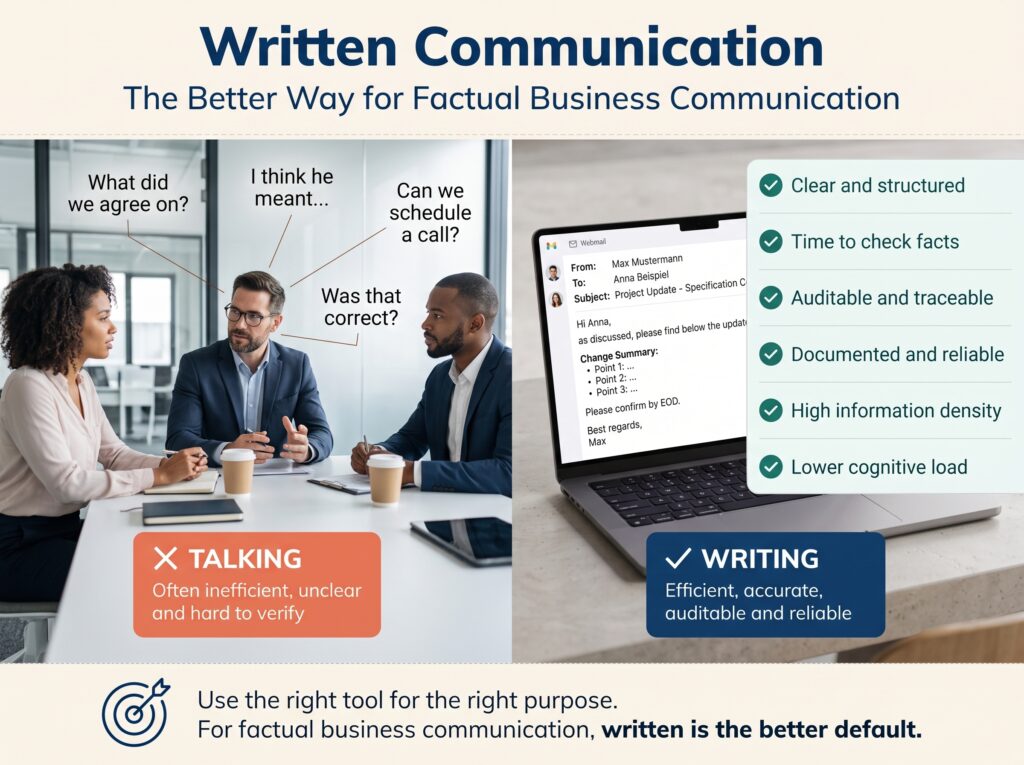
Written communication combines several advantages that are difficult to achieve simultaneously in a conversation.
It can be more efficient, more accurate and easier to verify.
It creates a traceable record, provides evidence when disagreements arise and allows information to be checked before decisions are made.
It also gives people more control over when they process and respond to information, reducing unnecessary cognitive load.
And with AI removing much of the time and effort traditionally associated with writing, written communication can now achieve an exceptionally high level of information density while remaining concise and professional.
For factual business communication, that makes writing more than a matter of personal preference.
It is often simply the more reliable way to work.

Leave a Reply